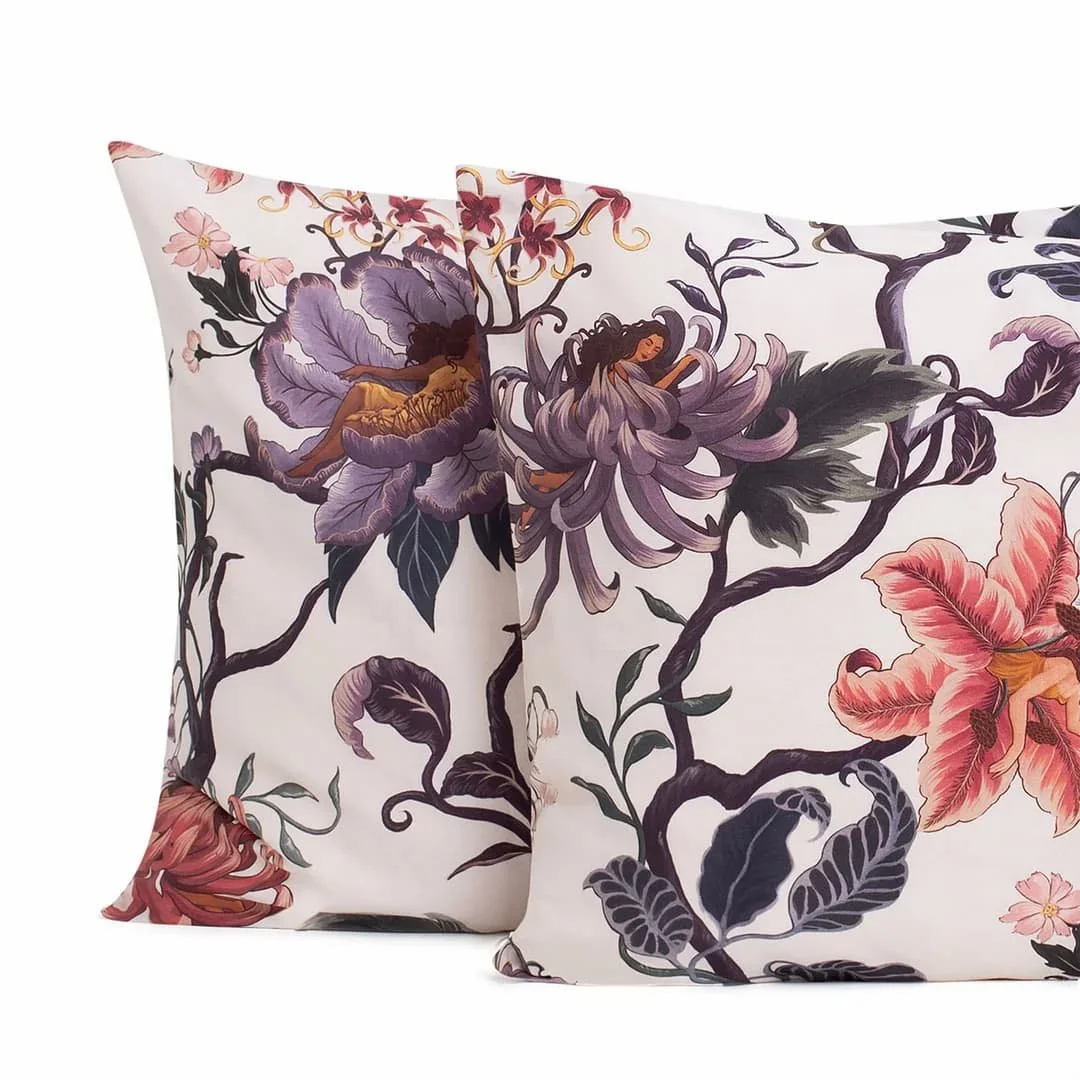
Cassie's home decor brand had built a devoted following with its dark, botanical aesthetic and commitment to sustainable production. When an unexpected feature in the New York Times sent growth from 20 per cent to 60 per cent year on year, she needed help navigating what came next.
I'd been working with Cassie as her business coach, with the focus on the transition every founder faces at a certain point - moving from a small business that revolves around one person to one with a team. This means learning to delegate, to trust other people with the work, and to build something that doesn't depend on you being in every room. That coaching relationship is where this story starts, because it's how I already understood Cassie's business when everything accelerated.
The Brand
Imagine what Florence Welch would buy for her home and you're close. Dark, botanical, with a witchy creative flair and an otherworldly glamour that captures something before other art forms have caught on. Think Nick Cave, The Vampire's Wife - a world that's gothic and celestial and unapologetically sensual. The designs always carry an edge which gives the brand an elusive quality that is hard to pin down while remaining deeply intriguing.
Cassie's brand speaks to a specific woman - progressive, culturally literate, drawn to the otherworldly - who wants somewhere she can be unapologetically herself. These are people who feel like outsiders - aesthetically, culturally, and in today's America, increasingly politically. Cassie has a significant LGBTQI following. The brand doesn't just reflect this customer. It gives her permission and encourages her agency. A place to be fully oneself in one's own home.
The Moment
It was a cultural fairytale - a brand that had built a devoted community on creative conviction and sustainable production. Growth had been steady, around 20 per cent year on year, and Cassie's plan was built around that. She knew her business, she knew her numbers, and she was growing at a pace she could manage.
Then the New York Times featured the brand. It went viral. And everything changed.
With growth exceeding sixty per cent, year on year, Cassie found herself unprepared for dealing with the challenges of scaling fast.Products taking six to nine months from design to warehouse. Demand outpacing Cassie's ability to fund it. And the timing made it urgent: in the US, the period from Thanksgiving through Black Friday to Christmas is the biggest retail event of the year. Billions of dollars in online sales over a single long weekend. For a home decor brand, this is the quarter that defines the year - and Cassie needed inventory she couldn't yet pay for.
Meanwhile, Cassie was pouring her creative vision into every campaign brief she wrote for her agencies and contractors, and watching the work come back as a version of the brand she barely recognised. What her contractors had to work from was a brand identity guide - the kind that covers colours, logos, and fonts. What they needed was a brand narrative, a copywriting style guide, and a clear articulation of who this brand speaks to and why it matters. Without that language, the contractors had defaulted to what they could see on the surface: gothic home decor for alternative women. A fraction of what the brand actually was - which was about psychological belonging and the freedom to be fully oneself.
Every piece of marketing that landed in the wrong place was money that could have been reaching the right people. And Cassie could see the distance growing between the brand she'd built and the way it was being represented. She wanted someone who could see the full picture and help her work out what to do. That's when our work shifted from coaching to consulting.
What I Found
I began by reviewing every ecommerce channel, and discovered revenue could double without spending a penny more from $3 million to $6 million annual turnover - simply by getting what Cassie already had working properly. The foundations needed to catch up.
The contractors had room to reach industry averages - and I wanted to understand why they were falling short. I audited the root causes, and the picture was layered. Some of it was capability. Some of it was brief - the language to represent what made this brand extraordinary simply didn't exist, so that even a talented contractor was working in the dark. And some of it was accountability: the business needed a clear framework for measuring performance against agreed standards.
The work had two tracks: stabilise the growth, and unlock the brand.
The Roadmap
On the growth side, we addressed the most urgent pressure first. Cassie needed to fund the inventory for Q4 - the Thanksgiving and holiday season that would define her year. We put in place a line of credit that gave her the capacity to place the orders she needed, so she could meet demand without compromising cash flow.
Then we turned to the contractors. This started with frank conversations about where things were at - the numbers, the KPIs, and what the business needed from each relationship. I ran a formal audit call to review performance against agreed metrics, and we set a 60-day trial window to re-establish the brief and turn things around. Clear expectations, clear metrics, a fair window to deliver.
On the brand side, I put together a brand positioning document that gave Cassie's agencies something they'd never had: the language for what this brand actually is, who it speaks to, and why it matters. A brand that sits across several dimensions simultaneously: part rebel, part lover, part magician, part playful trickster. A brand that resists a single archetype, which is both its strength and its communication challenge. Cassie created visual examples to sit alongside it - showing, not just telling, what the work should feel like. For the first time, her contractors had something nuanced to work from.
This was a short term solution. Underneath all of this was the deeper discovery - that what made this brand extraordinary deserved more than a positioning document. It deserved a brand strategy built to match. So I laid the groundwork that connected Cassie with a consultancy who've helped some of the world's most admired brands. That work is the second phase of this project - realising the true potential of the brand and taking it to a whole new level.
What's Happening Now
There's plenty happening behind the scenes. The brand strategy work is taking shape, the contractor relationships are reset on clear terms, and Cassie has a roadmap to support her fast growth. I couldn't be more excited to see it unfold, and to share the next chapter in Cassie's story when the time is right.
What I can say is this: Cassie came to me with extraordinary growth and a brand whose essence was still in her head. She left with a roadmap that addressed the immediate pressures and set her up for something bigger. That's what business consulting is for. Not just solving the problem in front of you, but using it as the springboard to build something stronger, more resilient, and more aligned with the future you want.
This is how I work with clients on business consulting. If Cassie's story resonates - whether you're navigating unexpected growth, watching your brand get lost in translation, or you know something needs to change and you want help working out what - I'd welcome a conversation about what a consulting project could look like for you.
Related
Strategic Hope: The Methodology at the Heart of The Purpose Company
Purpose-Led Business Consulting Explained